
During the lesson, the information for you to know is written in regular type, and what we suggest speaking or reading aloud to children is in bold. All resources for this lesson, including the Teacher Guide, Student Page, Family Connection Card, and other resources can be downloaded in a ZIP file by clicking on the following link:
In some lessons you will find "resource articles." These are articles written by experts from around the world to help equip you for your work with children and adolescents. Share them with parents or guardians if you consider it appropriate.
Do not repay evil with evil or insult with insult. On the contrary, repay evil with blessing, because to this you were called so that you may inherit a blessing.
1 Peter 3:9
The pain of betrayal is deep. It can last longer than physical pain. But Jesus understands this pain. He was betrayed by a close friend. In order to learn to forgive those who have hurt us, we must surrender all of our pain to God. We must choose to trust Him to bring justice in His time. And we must trust Him to heal our broken hearts so we can let go of our anger, bitterness, and desire for revenge.
The Holy Spirit can help us forgive those who have betrayed us. Ask God to remind you of those who have betrayed you. Allow His Spirit to walk you through all the emotions that came with that betrayal. Ask Him to heal your heart from that pain so you can begin to forgive and love.
Encourage the teens to show forgiving love to others in their lives. They can then think about how these people responded and how forgiveness made the teens feel.
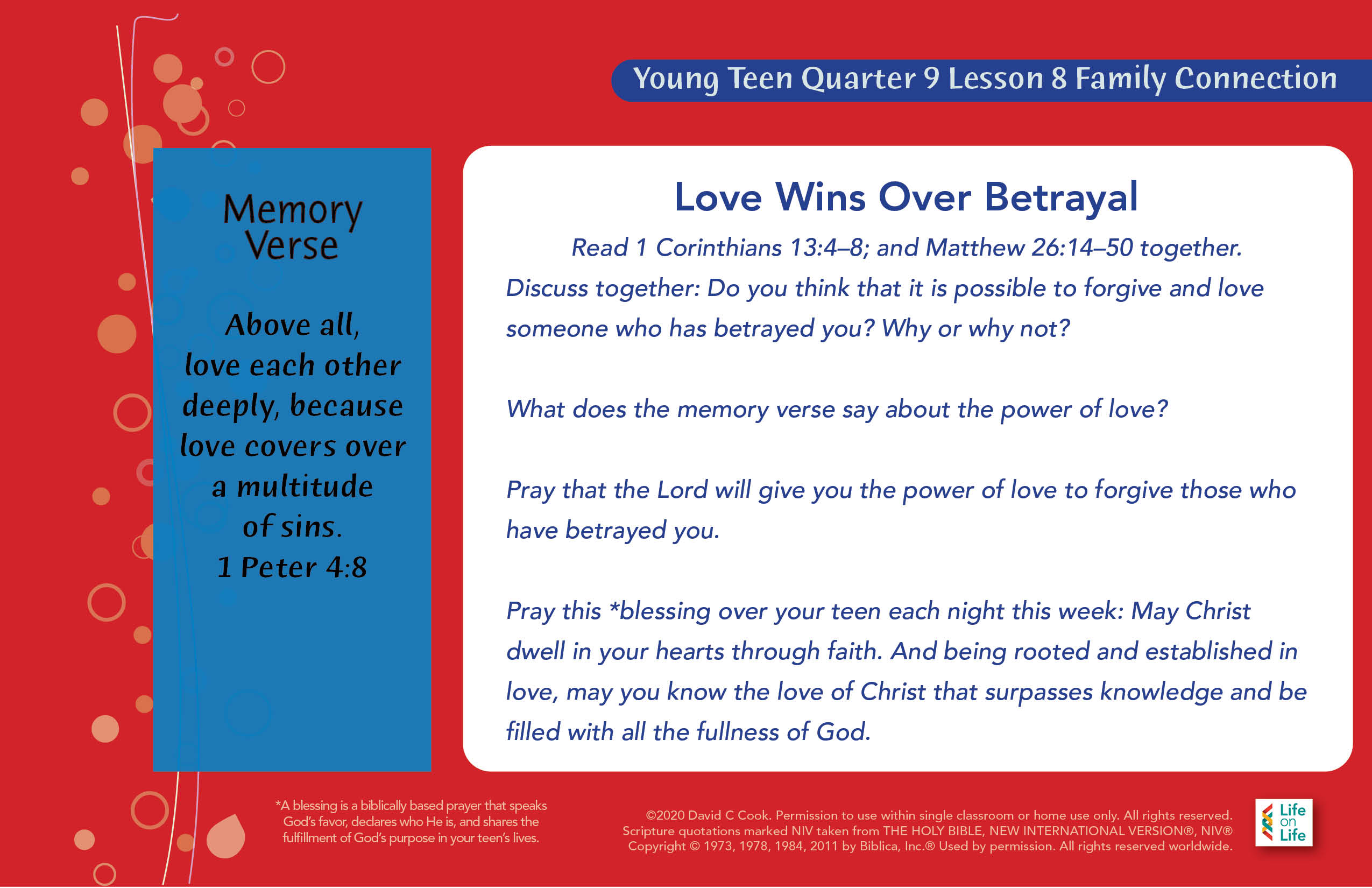
Teacher Tip: If possible, email or text the Family Connection Card to the families of your students.
As you greet students, ask them to tell you about 1 way they tried to be trustworthy since the last class. Congratulate those who had a story to share.
We will start today with a game to see which teams are the most powerful.
Clear a large space in the middle of your teaching area. Mark a line in the middle of the cleared area. Have the boys stand together, and the girls stand together. Divide the boys into 2 equal teams and the girls into 2 equal teams.
Have the 2 girls’ teams line up and stand on opposite sides of the marked line. The teams should be facing each other. The first person in each line should be about an arm’s length away from the first person in the other line. Do the same with the boys. You should have 2 girls’ teams facing each other and 2 boys’ teams facing each other.
Have the students grab the waist of the student in front of them. The first girls will grasp each other’s arms just below the elbow. Arrange the boys’ teams the same way.
Tell the teens that when you tell them to start, the 2 teams across from each other will pull in opposite directions. The goal is to pull the first 3 people from the other team across the marked line. When you are ready to begin, say, “Go!” If you have time, play the game again.
Have the class sit down. Then begin the discussion.
There are many powerful things around us. Some things are obviously powerful. Others may not seem powerful at first, but we later discover that they are. I am going to name some things, and you will choose which you think is the most powerful. Listen to both of the choices. Then I will repeat them, and you can vote for the more powerful thing by raising your hand.
Most of the comparisons in this activity have a factual answer. A few may depend upon interpretation. (For example, who is more powerful—a king or a president?) When you come to a comparison that does not have an obvious answer, invite the teens to share their thoughts about why one is more powerful than the other.
Which is more powerful?
For some of these things, you did not all agree. That is okay. Let’s talk about the last choice: love versus betrayal. Love is very powerful. Betrayal is powerful, too. Because they are both powerful, it can be difficult to know how to respond to those who have betrayed us. Today we will learn how love conquers all—even the pain of betrayal.
Love is so powerful that it never ends. Listen to what the Bible tells us about love.
Have a student read 1 Corinthians 13:4–8 aloud from the Bible. If that is not possible, the verses are printed here for you.
Love is patient, love is kind. It does not envy, it does not boast, it is not proud. It does not dishonor others, it is not self-seeking, it is not easily angered, it keeps no record of wrongs. Love does not delight in evil but rejoices with the truth. It always protects, always trusts, always hopes, always perseveres. Love never fails.
1 Corinthians 13:4–8a
What makes love so powerful?
Teens may give answers such as love comes from God, love is stronger than hate, or nothing can separate us from God’s love.
Listen to another verse about the power of love.
If you are using the Memory Verse Poster, show it to the students.
Above all, love each other deeply, because love covers over a multitude of sins.
1 Peter 4:8

What does this verse tell us about the power of love?
Allow 2–3 students to share their thoughts.
This verse makes it clear that love is very powerful. But how can it be more powerful than betrayal? The pain caused by betrayal is very deep.
Do you think it is possible to forgive and love someone who has betrayed you? Why or
why not?
Jesus understands betrayal. He was betrayed by a close friend. When Jesus was on earth, He travelled with 12 disciples. These men spent their days and nights with Jesus, learning all that He had to teach them about God’s kingdom. They were His closest friends.
The religious leaders opposed Jesus because they felt He was taking away their power over the people. One of Jesus’ disciples went to them and offered to betray Jesus. Let’s read the story from the Bible.
Then one of the Twelve—the one called Judas Iscariot—went to the chief priests and asked, “What are you willing to give me if I deliver him over to you?” So they counted out for him thirty pieces of silver. From then on Judas watched for an opportunity to hand him over.
Matthew 26:14–16
Why do you think Judas betrayed Jesus?
Allow 2–3 students to share their thoughts.
We do not know exactly why Judas betrayed Jesus. He may have done it for the money. He may have been trying to gain power for himself. Whatever the reason, Judas decided to betray Jesus. That betrayal had great consequences for Judas and for Jesus.
Not long after, Judas agreed to betray Him, Jesus had a special dinner with His disciples to celebrate the Jewish holiday called Passover. Let’s hear what happened at that dinner.
When evening came, Jesus was reclining at the table with the Twelve. And while they were eating, he said, “Truly I tell you, one of you will betray me.” They were very sad and began to say to him one after the other,
“Surely you don’t mean me, Lord?” Jesus replied, “The one who has dipped his hand into the bowl with me will betray me. The Son of Man will go just as it is written about him. But woe to that man who betrays the Son of Man! It would be better for him if he had not been born.” Then Judas, the one who would betray him, said, “Surely you don’t mean me, Rabbi?” Jesus answered, “You have said so.”
Matthew 26:20–25
Jesus knew Judas would betray him. Why do you think Jesus did nothing to stop him?
Teens may answer that Jesus still loved Judas or that He was following Father God’s plan that would have Him crucified for all our sins.
Soon after, Jesus went to the garden of Gethsemane with 3 of His disciples to pray. While Jesus was praying, the disciples fell asleep. Listen to what Jesus did.
Then he returned to the disciples and said to them, “Are you still sleeping and resting? Look, the hour has come, and the Son of Man is delivered into the hands of sinners. Rise! Let us go! Here comes my betrayer!” While he was still speaking, Judas, one of the Twelve, arrived. With him was a large crowd armed with swords and clubs, sent from the chief priests and the elders of the people. Now the betrayer had arranged a signal with them: “The one I kiss is the man; arrest him.” Going at once to Jesus, Judas said, “Greetings, Rabbi!” and kissed him. Jesus replied, “Do what you came for, friend.” Then the men stepped forward, seized Jesus and arrested him.
Matthew 26:45–50
Why do you think Jesus called Judas a friend?
Jesus still loved Judas even though Judas had betrayed him.
How do you think Jesus felt when one of His close friends betrayed him?
Guide the students to understand that Jesus likely felt the same emotions they have felt when someone betrayed them: hurt, sadness, anger, and fear.
After Jesus was betrayed, He was arrested, falsely accused, and sentenced to death. He was rejected by the people He came to save. He was stripped naked, beaten, and nailed to a cross, where He eventually died. Being killed on a cross was an extremely painful and humiliating way to die. Jesus endured the cross so that so our sins could be forgiven and we could know God’s love.
Optional: If possible, share the image from The Action Bible.

As Jesus was dying on the cross, He cried out to God. This is what He said.
Jesus cried out in a loud voice, “Eli, Eli, lema sabachthani?” (which means “My God, my God, why have you forsaken me?”)
Matthew 27:46
Why do you think Jesus said this?
Allow 2–3 students to share their thoughts.
It may seem that Jesus was crying out to God because He felt He had been abandoned. And because Jesus was fully human when He was on earth, He may have experienced these feelings of betrayal.
But when Jesus said this, He was quoting a verse in the Old Testament. In the passage, the psalmist cried out to God and asked why God had abandoned him. But then the psalmist remembered God’s faithfulness. Listen to what the psalmist wrote.
My God, my God, why have you forsaken me? Why are you so far from saving me, so far from my cries of anguish? My God, I cry out by day, but you do not answer, by night, but I find no rest. Yet you are enthroned as the Holy One; you are the one Israel praises. In you our ancestors put their trust; they trusted and you delivered them. To you they cried out and were saved; in you they trusted and were not put to shame.
Psalm 22:1–5
What do these verses teach us about betrayal?
We can trust God in every situation. His love for us never ends, and He will never betray us.
Jesus knows the deep pain of being betrayed by a close friend. He understands how it feels to be alone. But even in His great pain, Jesus showed us that love is more powerful than betrayal. He taught us to trust in God even as He was suffering. Listen to what else Jesus said as He was dying.
Jesus said, “Father, forgive them, for they do not know what they are doing.”
Luke 23:34
What are some ways we can respond to betrayal as Jesus did?
Allow 2–3 students to share their thoughts.
We can always cry out to God and ask Him to help us to heal and forgive. Here are some other things we can do to help us to heal from betrayal:
We can respond peacefully to those who betray us, learn to forgive, and remember that we are deeply loved. We can remember the example of Jesus, who was betrayed even as He was teaching us to love others. We can let love conquer betrayal in our lives.
Judas and the people who rejected Jesus were not the only ones who betrayed Him. Each one of us has also betrayed Jesus through our sinful thoughts and actions. But Jesus loves us, calls us His friends, and offers us forgiveness. Jesus’ love wins over betrayal! Listen to what the Bible tells us about God’s great love for us.
But God demonstrates his own love for us in this: While we were still sinners, Christ died for us.
Romans 5:8
As our perfect example, Jesus shows us that love wins over betrayal. Jesus forgave Judas for his betrayal, and Jesus forgives us when we call on Him for salvation.
That does not mean that the pain of betrayal will be erased. It does not mean that we can have loving relationships with everyone who has ever betrayed us. It does not mean that those we have betrayed will begin to trust us again. But it does remind us that we are loved by Jesus, who made a great sacrifice so that we could learn to forgive and so that we could receive forgiveness. It also reminds us that we can try to follow His example and forgive those who have betrayed us.
Have the teens line up facing the rope and holding it in both hands.
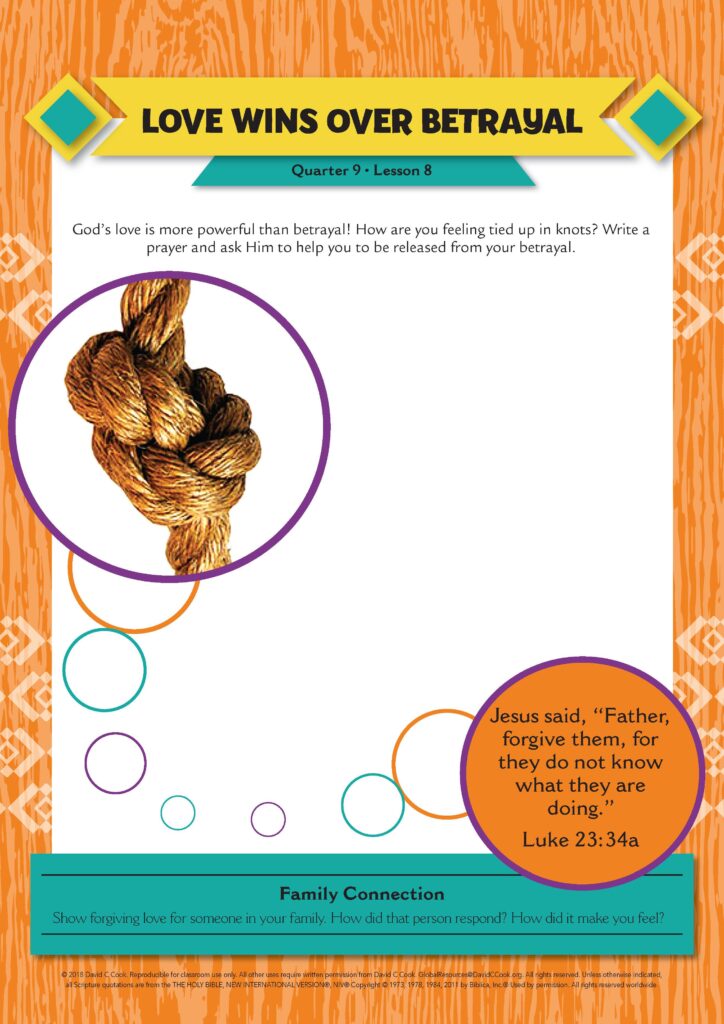
God’s love is more powerful than hatred, sadness, or betrayal. You may have been deeply hurt by someone you trusted. Living with that kind of deep pain can cause us to stop trusting others. It can cause us to feel angry. We can become so overwhelmed by our pain and anger that it is as if we are bound with a rope. It can keep us from experiencing healing and peace.
God understands, but His love is more powerful than anything that has happened to you. With His help, you can forgive the person who betrayed you and learn to trust again. It may be a slow process, but you can invite God to begin to heal your heart. Take a moment to think of a betrayal you have experienced. If you have not experienced betrayal, think of what it might feel like if you were betrayed by someone close to you. When you are ready to trust God’s love to help you heal, let go of the rope and let it drop from your hands.
Give the students a few minutes to respond.
Optional: If you are using the Student Pages, the teens can write a prayer on their pages.
Then close with a blessing based on Ephesians 3:17–19:
Blessing: May Christ dwell in your hearts through faith. And being rooted and established in love, may you know the love of Christ that surpasses knowledge and be filled with all the fullness of God.
Lead the children in singing this quarter’s song, if possible.
Life on Life ©2020 David C Cook. Reproducible for home or classroom use only. All other uses require written permission from David C Cook [email protected]. All rights reserved.