
During the lesson, the information for you to know is written in regular type, and what we suggest speaking or reading aloud to children is in bold. All resources for this lesson, including the Teacher Guide, Student Page, Family Connection Card, and other resources can be downloaded in a ZIP file by clicking on the following link:
In some lessons you will find "resource articles." These are articles written by experts from around the world to help equip you for your work with children and adolescents. Share them with parents or guardians if you consider it appropriate.
If you are using mud, mix a batch of thin mud and pour it into cups. You should have 1 cup for each group of 4 children. Be sure there is enough mud for each child to paint a stone.
A second cup should be given to each group whether you are using mud or paint. Pour enough water into each cup to allow children to rinse their fingers as they paint.
We are receiving a kingdom that can’t be shaken. So let us be thankful. Then we can worship God in a way that pleases him. Let us worship him with deep respect and wonder.
Hebrews 12:28
As humans, we sometimes worry about things we cannot control and things that seem too much for us to handle. However, we can take comfort in God’s promise: we are receiving a kingdom that cannot be shaken! Even when our families experience hardship or our leaders make decisions we disagree with, we can be thankful that God’s kingdom remains strong.
Has your life been affected by things you did not expect to happen? Take comfort and thank God that changes in your circumstances do not change His kingdom! Rather than putting your hope in the constantly changing world, you can put it in the God who does not change. So praise Him for all of the wonderful things He has done. Praise Him with a grateful heart!
Encourage families to practice finding something they are grateful for that is always present in their lives, such as something from nature, their health, or the love of God or a family member. Ask them to discuss ways they can focus on this thing, even when their circumstances are difficult.
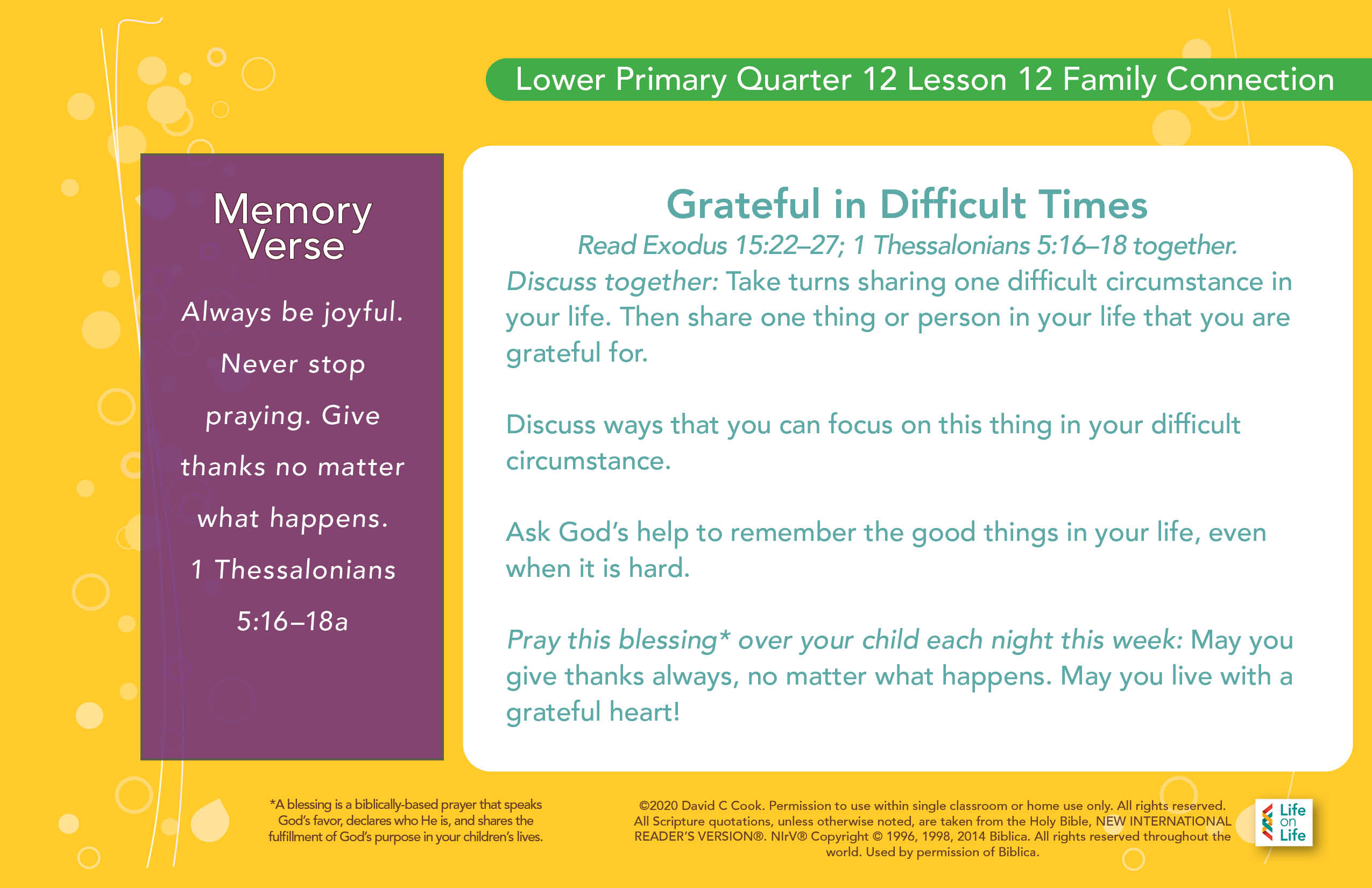
Teacher Tip: If possible, email or text the Family Connection Card to the families of your students.
Welcome the children as they come to class. Ask each child to find a partner and tell her 1 person he is grateful for. When you are ready to begin class, have the children line up across the space. Have the children stand fairly close to each other. Stand with the ball at 1 end of the line.
Optional: If you have more than 20 children in your class, you can divide the class in half and form lines for this activity.
Let’s begin with a fun challenge! For this challenge, you will try to pass this ball from the front of the line to the back. To do this, you may toss, give, or roll the ball to the next person in the line. You may turn around or move closer to the next person, but you must stay in your place in line.
Give the ball to the first child in line. Encourage the children as they pass the ball to each other. When the ball reaches the end of the line, take the ball and congratulate the children for completing the task.
Ask the children to face the child at the front of the line. Then have them spread out so that when they stretch their hands in front of them, it is difficult for them to reach the child in front of them. Stand with the ball at the front of the line.
Now, let’s try to make this activity more challenging. This time, when you pass this ball to the next person in line, you cannot turn around or move your feet! You must figure out a way to pass the ball to the child behind you without turning around to face her or moving from your place.
Show the children the following actions as you read them so the children know what they can do.
You may bend down to roll the ball or toss the ball behind you, but you cannot move from your place.
Give the first child in line the ball and tell him to begin. If the ball rolls away from the line, you may need to pick it up and give it to the next child in line. It will be important for you to help the ball to keep moving down the line while also allowing time for each child to try to pass the ball. When the ball reaches the last child in line, ask the children to face you and sit down.
Wow, that was a difficult challenge!
The first way we played the game, when we were all able to turn and move, is like being grateful when our lives are mostly happy and good. When things are easy, we see the good things that are happening and can be grateful for them. The way we played the game the second time, when we could not turn around or move from our places, is more like being grateful when we experience a challenge. It is difficult to see the good things that are happening, and we often miss them.
However, even in difficult times, there are always things we can be grateful for. In our game, you were working together toward a goal, you were trying your best, and you had my help. These are all good things, even if the activity felt very difficult. Let’s learn more about how we can be grateful even in difficult situations.
A few weeks ago, you heard a true story from the Bible about the Israelites being freed from Egypt. In the story, the Israelites were slaves in Egypt. Pharaoh agreed to let them go but changed his mind and sent his soldiers to get the Israelites back. The Israelites were trapped between the soldiers and the Red Sea. God made a dry path through the Red Sea so the Israelites could cross. Once the Israelites were across, He closed up the path so the Egyptian soldiers could not capture the Israelites. Moses, Aaron, and Miriam celebrated the great thing God had done.
After Miriam and some of the other women celebrated what God had done, the Israelites began a very long and difficult journey through the desert. It took 3 days after leaving the Red Sea for them to find water.
How do you think they felt traveling in the hot desert for 3 days without water?
Allow 2–3 children to respond. Be sure at least 1 child mentions that they must have been very thirsty.
The Israelites must have been very thirsty! Finally, they saw water! Listen to what the Bible tells us happened when they finally found water.
If possible, read the verse directly from your Bible.
When they came to Marah, they couldn’t drink its water. It was bitter. That’s why the place is named Marah.
Exodus 15:23
Yes, that is right. The Israelites were very thirsty, and they finally found water. But they could not drink the water because it was too bitter!
How do you think the Israelites felt when they found out they still did not have water they could drink?
Allow 1–2 children to respond.
Listen to what the Israelites said.
The people told Moses they weren’t happy with him. They said, “What are we supposed to drink?”
Exodus 15:24
Allow 1–2 children to answer each of the following questions.
Do you think they remembered their gratefulness to God for helping them cross the Red Sea? Why or why not?
No, because the people were angry that they did not have water they could drink.
What could the Israelites have been grateful for?
The Israelites were in a difficult situation. Even though God had helped them to get out of Egypt, the Israelites were not happy. They allowed their difficult situation to keep them from being grateful for the good things God had done.
Let’s listen to what happened next to Moses and the Israelites. Moses asked God for help. God made the water clean so the Israelites could drink it, and He later provided both food and water for the Israelites in the desert. God took great care of the Israelites. Even in their difficult situation, they had a lot to be grateful for.
We have a lot to be grateful for, too. The Bible reminds us it is important to be grateful at all times. Listen for the important instructions included in these verses about when we should give thanks to God.
Always be joyful. Never stop praying. Give thanks no matter what happens. God wants you to thank him because you believe in Christ Jesus.
1 Thessalonians 5:16–18
This Bible verse says to give thanks no matter what happens. When I say, “Give thanks,” you will say, “No matter what happens.”
Say, “Give thanks,” and encourage the children to respond by saying, “No matter what happens.” Repeat this 2 more times.
Sometimes when difficult things happen to us, we complain and worry about what might happen next.
What can we do instead of worrying and complaining?
Say, “Give thanks,” and encourage the children to say, “No matter what happens.”
I will read some ways we can be healthier when we choose to be grateful in difficult times. After each, I will say, “Give thanks,” and you will say, “No matter what happens.”
Even in difficult situations, we can choose to be grateful for the good things and people in our lives. Focusing on good things and people will help us through our challenges.
Have the children sit in groups of 3–4. Place the stones at the front of the space.
When we face difficult situations, thinking about what we are grateful for can help us. Let’s decorate stones to help remind us of things we are grateful for. In a moment, I will give each of you a stone to decorate with a picture of something you are grateful for. Then your stone can help you to remember something or someone you are grateful for.
Think of a difficult situation that has happened in your life. Maybe your family did not have enough food to eat. Maybe the aunt who cares for you was very sick. Maybe you were bullied at school. You will not be asked to share this with the class. Think of 1 difficult situation you have experienced. When you have thought of something, put a thumb up in front of you.
Pause for about 30–45 seconds or until most of the children have their thumbs up.
Now, think of something you are grateful for. This could be something from your daily life, such as having a place to sleep at night, or it could be something from the difficult situation. For example, if your difficulty is that you do not have many friends and you are often lonely, you can be grateful God loves you and is always with you. Take a moment to think of something or someone you are grateful for.
Allow 30 seconds for the children to think about what they are grateful for.
In a moment, you will each paint a picture of something or someone you are grateful for on a stone. Think about what you can paint on your stone to show what you are grateful for. For example, I am grateful to have a place to worship God, so I might paint a church.
Use the mud or paint to draw a church on your stone. This will be a very basic drawing.
To show the thing or person you are grateful for, what might you paint? Share your ideas in your groups.
Allow 1–2 minutes for the children to share their ideas in their groups.
You may now get a stone from the front of the space and return to your group.
Invite the children to the front of the space to get their stones. As they choose their stones, you will give 1 container of mud or paint and 1 cup of water to each group. When the children return to their groups, give them 2–3 minutes to paint what they are grateful for.
Optional: If you are using the Student Pages, allow children to draw different things they are grateful for in each outline of a stone.
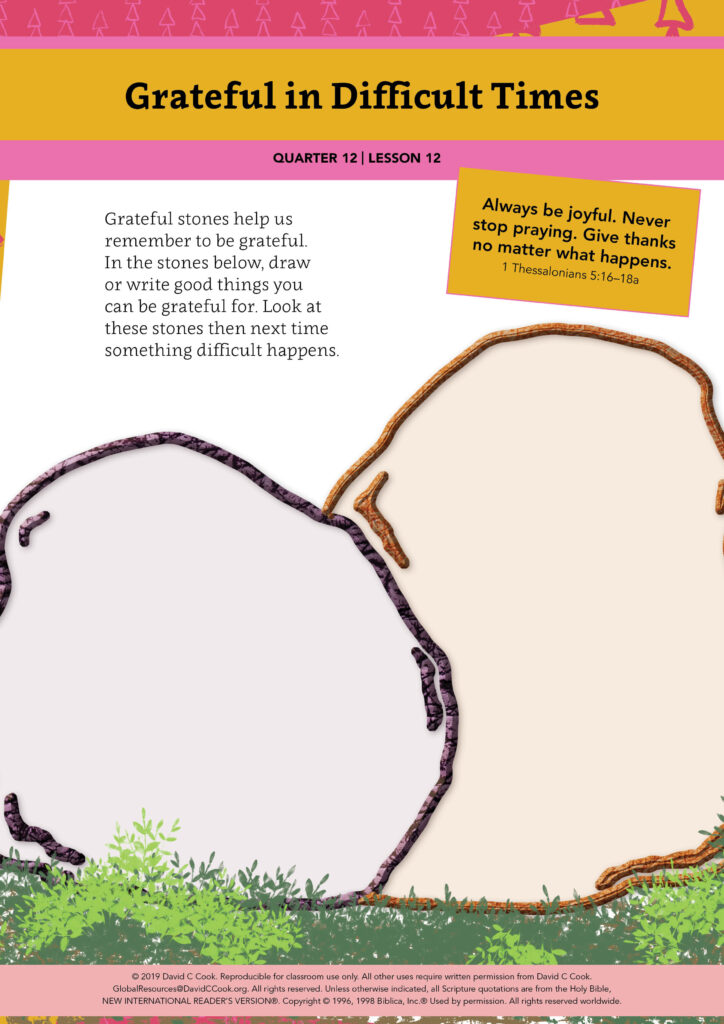
You can take your grateful stone home with you and place it somewhere you will see it often. When something difficult happens to you, you can look at your stone to remind you of the things you are grateful for. Every time you see your stone this week, thank God for 1 good thing. Our memory verse this week reminds us to be grateful at all times.
If you are using the Memory Verse Poster, show it to the students.
Always be joyful. Never stop praying. Give thanks no matter what happens.
1 Thessalonians 5:16–18a

Use the rhythm you created in Lesson 9 for the memory verse as you say this verse. Then, encourage the children to say the words and clap the rhythm with you 3 times.
End class by saying this blessing, based on 1 Thessalonians 5:18, over the children.
Blessing: May you give thanks always, no matter what happens. May you live with a grateful heart!
Lead the children in singing this quarter’s song, if possible.
Life on Life ©2020 David C Cook. Reproducible for home or classroom use only. All other uses require written permission from David C Cook [email protected]. All rights reserved.